



Teams
For fast-scaling teams that need observability to scale with them.
Starts from
$49/month
.md to documentation URLs.SigNoz Cloud brings your traces, metrics, and logs into one OpenTelemetry-native platform. Simple usage-based pricing, and the freedom to run on your infrastructure with Self-Hosted SigNoz.
Move from symptoms to evidence across APM, logs, traces, infra, LLM telemetry, alerts, and dashboards.
Explore DocsUse the SigNoz MCP server to bring telemetry into coding agents, or use Noz, your AI teammate inside SigNoz Cloud, to investigate incidents, tune alerts, and build dashboards with the same production context your team sees.
Explore MCP and Noz


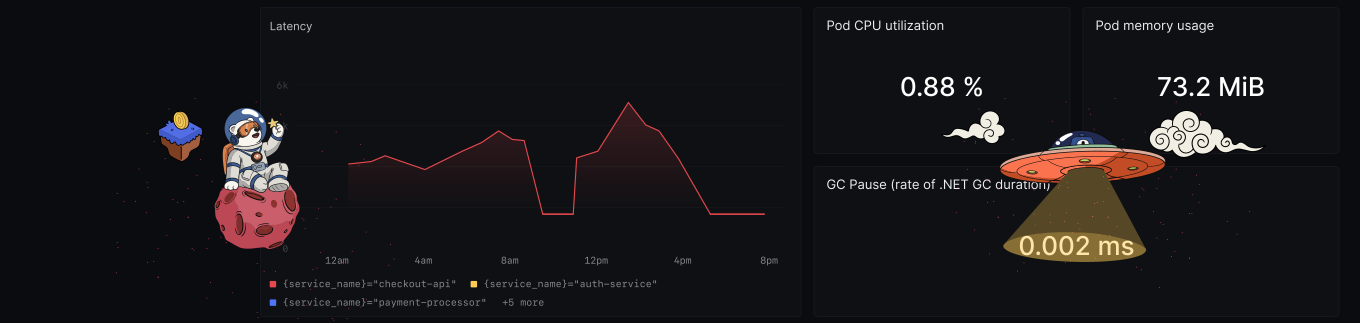
Move from a latency spike to the related logs, traces, metrics, and spans without stitching together separate tools.
Use open standards instead of vendor SDKs, so instrumentation stays portable as your stack changes.
Use query builder, PromQL, and ClickHouse SQL on a fast columnar datastore built for high-cardinality observability data.
One OpenTelemetry-native source gives agents a known schema for traces, logs, metrics, and services, so they can debug with less translation.
Built for scale
For fast-scaling teams that need observability to scale with them.
Starts from
$49/month
For larger orgs that need data residency, compliance, and support.
Starts from
$4,000/month
Add teammates freely, monitor autoscaling infrastructure, and estimate telemetry costs before you commit.
View PricingNo host-based pricing
Autoscale infrastructure without turning every node, container, or host into a billing surprise.
No user-based pricing
Bring engineering, support, and on-call teams into SigNoz Cloud without seat limits or seat math.
Simple usage-based pricing
Send any mix of logs, traces, and metrics. Pay for telemetry volume, not custom metrics complexity.
Switch to
SigNoz Cloud
We’ve transitioned from Grafana to SigNoz, offering a simplified, unified monitoring, logging, and alerting experience.
 Mark NelsonOracle
Every single time we have an issue, SigNoz is always the first place to check.
 Karl LyonsShaped
SigNoz powers 10,000+ engineering teams. From ambitious start-ups to major enterprises.
Customer Stories How Shaped fixed a year-old latency bug with SigNoz MCPRead more
 Building observability for the AI era: agent-native and AI-scale telemetryRead more
 Introducing the new trace detail viewRead more
Quick answers to the questions teams usually ask while evaluating SigNoz Cloud.
Most teams start with OpenTelemetry instrumentation or the OpenTelemetry Collector. For Kubernetes, the SigNoz Helm chart can collect cluster metrics, logs, and traces; for AWS, CloudWatch logs can be routed to SigNoz Cloud. Your exact path depends on your language, cloud, and whether you use SigNoz Cloud or Self-Hosted SigNoz.
Yes, for teams that want logs, metrics, traces, dashboards, alerts, and infrastructure monitoring in one OpenTelemetry-native product. Many migrations start by sending OpenTelemetry data to SigNoz Cloud, then rebuilding the dashboards, alerts, and incident workflows that matter most.
SigNoz Cloud pricing is usage based. There is no user-based pricing, no host-based pricing, and no special pricing for custom metrics. Teams can estimate cost from expected logs, traces, metrics volume, and retention with the pricing calculator, then use ingestion controls to drop noisy telemetry before it is stored.
Yes. Choose Self-Hosted SigNoz when you want to operate the observability stack on your own infrastructure. SigNoz Cloud also offers managed regions and enterprise deployment options, including dedicated cloud and bring-your-own-cloud, for teams that need data residency, compliance reviews, SSO, migration help, or stronger deployment control.
Yes. SigNoz supports alerts on metrics, logs, traces, exceptions, anomaly detection, and Apdex. You can send notifications to channels like Slack, PagerDuty, Opsgenie, MS Teams, email, or webhooks, and use routing policies to send alerts to the right team based on labels such as service, severity, or environment.
SigNoz Cloud keeps logs, traces, metrics, exceptions, dashboards, and alerts connected in one workspace. Teams can move from a latency spike to related traces, from a trace to surrounding logs, or from an alert to the service and attributes behind it without stitching context across separate tools.


